

Reviewed by Coach Sun Ping, Head Coach & Founder, Fly Once Gymnastics · Last updated 26 November 2026
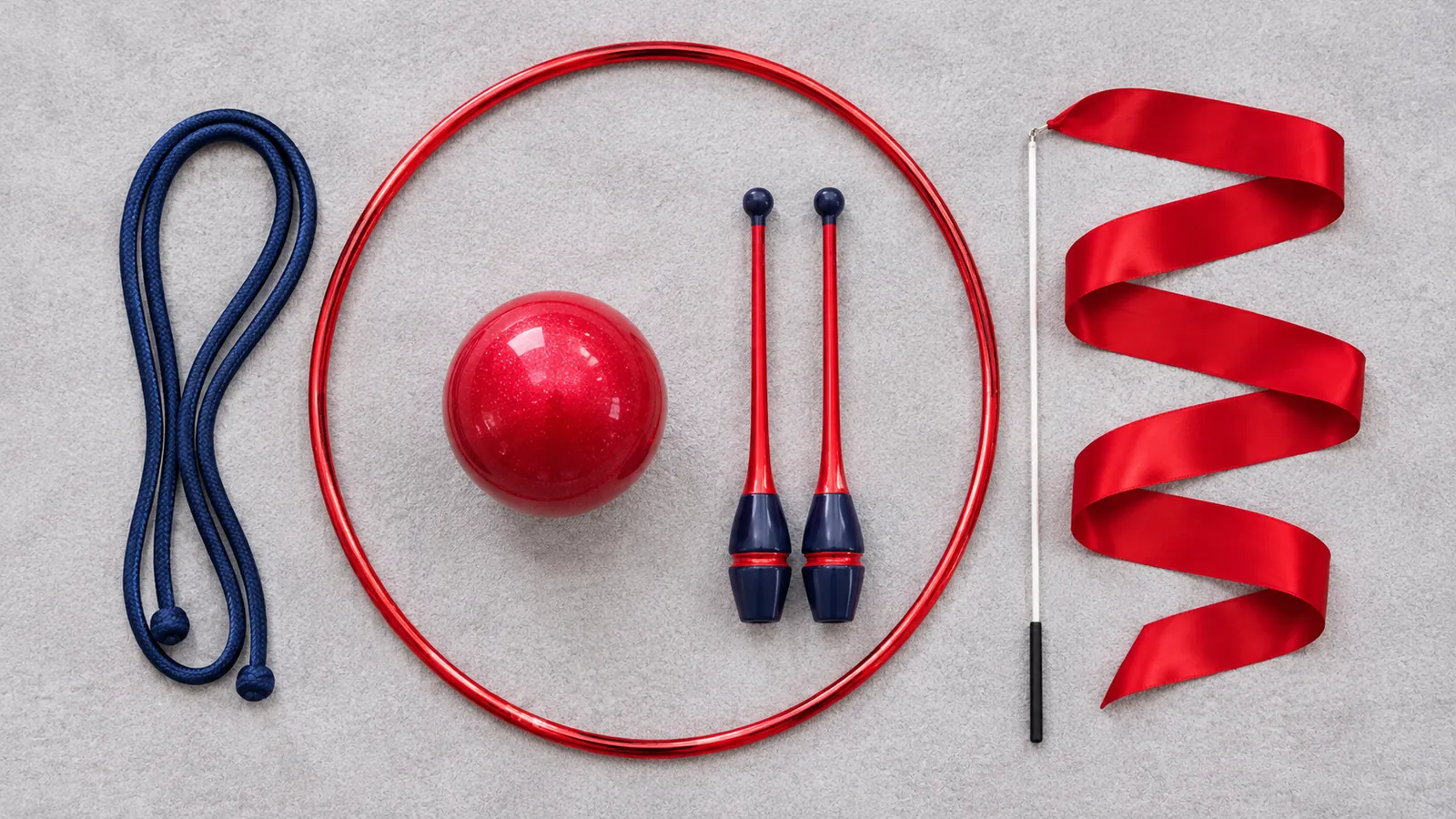
Quick answer: Rhythmic gymnastics uses five hand apparatus: rope, hoop, ball, clubs and ribbon. Each one trains different skills, from jumping and timing with the rope to continuous flowing movement with the ribbon. Young gymnasts usually start with freehand routines and the ball, then add more apparatus as they grow. Your coach will advise which apparatus and size your child needs.
The apparatus is what makes rhythmic gymnastics unique. A gymnast doesn’t just leap, turn and balance; she throws, catches, rolls and spins an apparatus at the same time, all set to music.
This guide explains each of the five apparatus, what it trains, when children usually start using it, and what to buy.
What are the five rhythmic gymnastics apparatus?
| Apparatus | What it looks like | Main skills it trains |
|---|---|---|
| Rope | Skips, jumps and swings, often with the rope held in one or both hands | Jumping, timing, coordination |
| Hoop | Rolls along the body or floor, spins on the hand, passes through the hoop | Spatial awareness, rotation, precision |
| Ball | Rolls over the arms and back, bounces, balances on the hand | Control, smoothness, body awareness |
| Clubs | Small circles (“mills”), asymmetric swings, throws of one or both clubs | Rhythm, hand coordination, using both sides of the body |
| Ribbon | Spirals and snakes drawn in the air, kept moving without stopping | Continuous flow, wrist control, expression |
Gymnasts also perform freehand routines with no apparatus, which build the leaps, balances and turns every routine depends on.
What does each apparatus train?
Rope. Rope work is built on jumps and skips, so it develops timing, leg strength and coordination between hands and feet. It’s often one of the first apparatus children handle in class.
Hoop. The hoop rolls along the floor and body, spins around the hand and is thrown high. Gymnasts learn spatial awareness and precision, because catching a spinning hoop leaves very little margin for error.
Ball. The ball must never be gripped; it rests in the open hand. That makes it ideal for teaching control and smooth, flowing movement. Rolling the ball across both arms or down the back is a classic skill.
Clubs. Clubs are the most technical apparatus. Gymnasts swing two clubs in small circles, often in different directions at once, which trains rhythm and coordination on both sides of the body.
Ribbon. The ribbon must stay in constant motion, drawing spirals and snakes in the air. It’s the most recognisable apparatus and one of the hardest to master, because any pause makes the ribbon fall or tangle.
Which age uses which apparatus?
Children don’t learn all five apparatus at once. On Singapore’s Elite Pathway, which follows World Gymnastics age groups, apparatus is added year by year:
| Age group | Freehand | Ball | Hoop | Clubs | Ribbon |
|---|---|---|---|---|---|
| 6 | ✓ | ||||
| 7 | ✓ | ✓ | |||
| 8 | ✓ | ✓ | ✓ | ||
| 9 | ✓ | ✓ | ✓ | ✓ | |
| 10 | ✓ | ✓ | ✓ | ||
| 11–13 | ✓ | ✓ | ✓ | ✓ | |
| Junior (14–15) and Senior (16+) | ✓ | ✓ | ✓ | ✓ |
In kinder and recreational classes, children try several apparatus early through games, so they get used to the feel of each one. The rope is mostly used by younger gymnasts and at national levels.
What size apparatus does my child need?
Apparatus comes in different sizes for different ages. For senior international competition, World Gymnastics sets standard sizes, roughly:
| Apparatus | Senior size (approximate) |
|---|---|
| Hoop | 80–90 cm inner diameter |
| Ball | 18–20 cm diameter |
| Clubs | 40–50 cm long |
| Ribbon | About 6 m of ribbon on a 50–60 cm stick |
| Rope | In proportion to the gymnast’s height |
Children use smaller, lighter versions. The right size depends on your child’s height and level, so check with your coach before buying.
What does my child need to buy?
For a trial class, your child doesn’t need any apparatus. If she already has a rope or ball, she’s welcome to bring it.
Once she joins a class, her coach will tell you which apparatus to buy and in what size. Most beginners start with a ball and a rope, then add the others as they progress. Buying the right size from the start saves money and helps your child learn the correct technique.
Learning the apparatus at Fly Once
At Fly Once, 4-year-olds in our first kinder class (Bubbly) start with physical development and basic movement through fun games, and the apparatus are introduced step by step. As they move into beginner, recreational and competitive classes, coaches build technique on each apparatus step by step, following Singapore Gymnastics’ National Programme.
Our rhythmic programme is led by Head Coach and founder Sun Ping, a certified FIG coach and Singapore Gymnastics judge with more than 32 years of coaching.
Want to know which age to start? Read what age to start rhythmic gymnastics. For how levels and age groups work, see National Pathway vs Elite Pathway.
Ready to try? Book a trial class or WhatsApp us at +65 8126 0601.
Frequently asked questions
What are the five apparatus in rhythmic gymnastics?
The five apparatus are rope, hoop, ball, clubs and ribbon. Gymnasts also perform freehand routines without apparatus.
Which rhythmic gymnastics apparatus is the hardest?
Clubs and ribbon are usually considered the hardest. Clubs need precise coordination of both hands, and the ribbon must stay in constant motion without tangling.
At what age do children start using apparatus?
Children try apparatus such as the ball and hoop in kinder classes from age 4. On the Elite Pathway, competition routines add the ball at 7, hoop at 8, clubs at 9 and ribbon from 11.
Does my child need to buy apparatus for a trial class?
No. Apparatus isn’t needed for a trial class. If your child already has a rope or ball, she can bring it.
What size hoop or ball should my child use?
It depends on your child’s height and level. Children use smaller, lighter apparatus than senior gymnasts, so ask your coach before buying.
How long is a trial class at Fly Once?
A trial class at Fly Once is one hour, including a coach assessment and programme recommendation.